April was a strong cashflow month for me. Five of my holdings paid out a combined $1,064.76 in dividends. That sounds like the kind of number a "dividend investor" would post, except I'm not one.
I don't pick stocks for their yield. I focus on total return. Here is why, and what April actually looked like.
The April breakdown
Most of the cash came from one position. Emaar Properties paid out $975.78, which is by far the biggest dividend in my portfolio. The rest was a mix of US semiconductor names and a UAE bank.
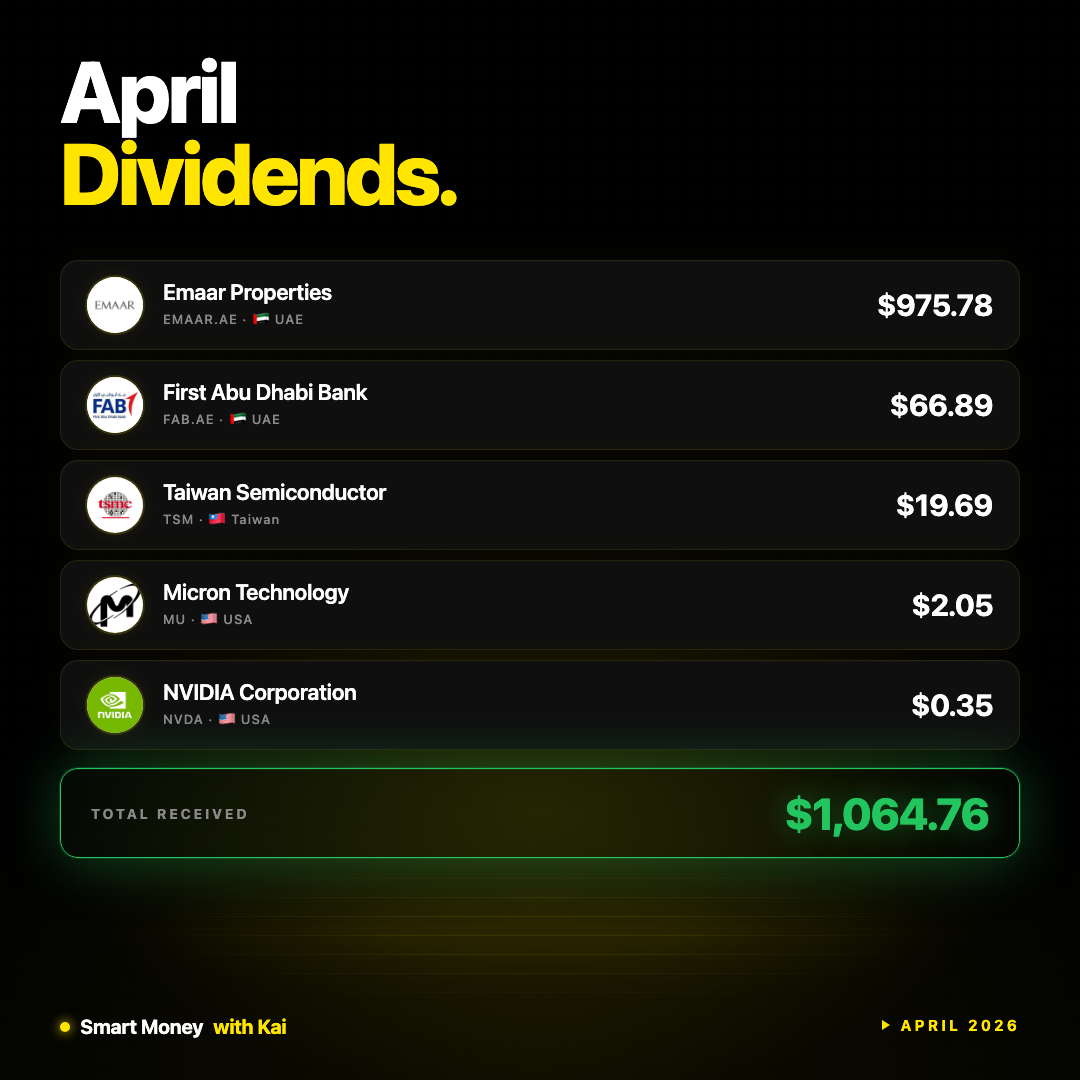
Notice how lopsided that is. One Dubai property developer paid more than the other four combined. If I were optimising for "dividend income," I would have a heavily concentrated UAE-real-estate portfolio. I don't, because that is not the game I'm playing.
Why I don't pick stocks for yield
The number that actually matters when you own a stock is total return. Total return is the share price change plus any dividends paid out, measured against what you originally invested. It is the only number that tells you whether you actually made or lost money.
Dividend yield by itself tells you almost nothing. It is one component of total return, dressed up as the headline.
The yield trap
Here is the math that most yield-chasers miss. A 6% dividend looks generous on paper. If the stock drops 8% over the same period, your total return is negative. You collected the cash and still lost money on the position.
A "boring" 3% yielder whose share price climbed 12% beats it cleanly.
This is not a hypothetical. It is what plays out across the dividend ETF universe every year. Funds packed with high-yield names regularly underperform broader index funds because the share-price drag eats the payouts.
If you only track yield, you are reading one column of a two-column scorecard. Total return is the only number that closes the loop.
When dividends actually matter
None of this means dividends are bad. Getting paid while holding a stock is a real benefit, especially in flat or sideways years where price appreciation does most of nothing. A steady payout from a quality business cushions the boring stretches and gives you cash to redeploy.
In my case, every dollar of these April dividends is reinvested. That is where the compounding happens. The reinvested shares pay their own dividends next year, and so on. Over a decade or two, that snowballs.
What I avoid is treating yield as the reason to own a stock. The reason to own a stock is the underlying business, the price you paid, and the total return I expect over my holding period. The dividend is a nice-to-have, not the thesis.
What I actually track
For each position, I track total return since I bought it. Price change, plus dividends received, divided by my cost basis. That is the only column on the scorecard that matters. If the total-return column on a position has been negative for a long time, the high yield does not save it.
If you want to see how this plays out across my full portfolio, I broke it down in my April 2026 portfolio update, the biggest single-month gain I have ever recorded, and you can see why I shifted heavily into individual stocks in the piece on why I sold my ETFs. For an end-of-year version of this thinking, the annual portfolio review checklist walks through what to actually measure when you sit down with your holdings.
Frequently Asked Questions
Dividends are not bad. Getting paid while holding a stock is a real cash return. The trap is treating yield as the main reason to own a stock. A high yield can mean the share price is falling faster than the payout, which leaves you with a negative total return.
Total return is share price appreciation plus any dividends paid out, expressed as a percentage of what you originally invested. It captures the full result of holding a stock, not just one component of it.
Reinvesting dividends increases your share count without you adding new money. Over a long enough holding period, those reinvested shares pay their own dividends and grow with the share price, which is where compounding comes from.
Not automatically. A high yield from a stable business with a growing share price is fine. A high yield from a falling share price is a warning. The yield itself does not tell you which is which, you have to look at total return over time.
Disclaimer: This article is for educational purposes only and does not constitute financial advice. When investing, your capital is at risk. You may get back less than you invested. Past performance is not a guarantee of future results.