You are having a great week. Work is going well, the sun is out, life is good. Then you open your investing app and your mood tanks because your portfolio is down 2%. Two minutes ago you were fine. Now you are anxious, wondering whether you should sell everything and stick with a savings account.
If that sounds familiar, you are not alone. That reaction is one of the biggest reasons why most investors underperform the market over the long term. Here are six mistakes you should avoid if you want to become a better investor. If you are brand new, start with my complete beginner's guide to investing first.
1. Checking Your Portfolio Every Day
This is probably the most common mistake. When you have money in the market, it is tempting to check how it is doing every hour. But there is a real psychological cost to that habit.
Daniel Kahneman, who won the Nobel Prize for his research on decision-making, showed that we feel losses roughly twice as strongly as equivalent gains. If your portfolio goes up by 2%, you feel a little happy. If it drops by 2%, you feel twice as bad. The emotions are simply not equal. A sibling bias I wrote about separately, price anchoring, does the same thing in reverse. It makes good stocks feel "too expensive" just because you remember buying them cheaper.
Now think about what happens when you check your portfolio every day. On any given day, the market is roughly a coin flip. It goes up about 53% of the time and goes down about 47% of the time. So nearly half the time you look, you are going to feel the sting of a loss, even though these daily movements mean absolutely nothing for long-term wealth creation.
There is a famous finding by Fidelity that looked at which clients had the best-performing portfolios. You would expect it to be the most active traders, the ones constantly researching and optimising. But it was actually the opposite. The best performers were accounts that had not been touched in years. Some belonged to people who had forgotten about their accounts entirely, and some had even passed away. The fix is doing your homework up front so you can hold with conviction, which is exactly how I research a stock before I buy.
The lesson is simple. The less you tinker, the better you tend to do. Set up your investment account, automate your contributions, and then step away. Check it once a month if you want, but daily checking is just hurting you.
2. Ignoring the Fees
This one is sneaky because fees do not feel like a big deal when you see them as a small percentage. But when they compound against you year after year over a 20 or 30 year investing horizon, they eat a massive chunk of your returns.
It is not just the obvious fees like platform charges or fund management fees. You also need to pay attention to foreign exchange fees when buying US stocks from a European account. And then there are spreads, which most beginners never think about.
What is a spread?
Say a stock has a market price of around 100 euros. When you go to buy it from your broker, you do not actually pay 100 euros. You pay the ask price, which might be 101 euros. And if you were to sell it at the same moment, you would get the bid price, which might be around 99 euros. That 2 euro gap between the buy and sell price is the spread. The moment you buy, you are already down 1% before the stock has even moved.
Some brokers have much wider spreads than others, and that adds up every single time you make a trade.
Same money in, same investments, completely different outcome. Take the time to compare brokers and look at the full picture: platform fees, fund fees, FX fees, and spreads. Platforms like Trading 212 offer zero commissions on all trades, while Interactive Brokers has some of the lowest FX fees in the industry. It is one of the very few things you can actually control as an investor.
3. Waiting Until You Have "Enough" Money
One of the biggest myths about investing is that you need thousands of euros to get started. That might have been true 20 years ago, but today many brokers let you buy fractional shares from as little as 1 euro. Platforms like Trading 212 and eToro make this easy. You can own a piece of companies like Amazon, Microsoft, or an S&P 500 ETF without needing hundreds or thousands of euros for a single share. If you are new to it, I wrote a step-by-step guide on how to start investing with Trading 212.
eToro is a multi-asset investment platform. The value of your investments may go up or down. Your capital is at risk. Sponsored link.
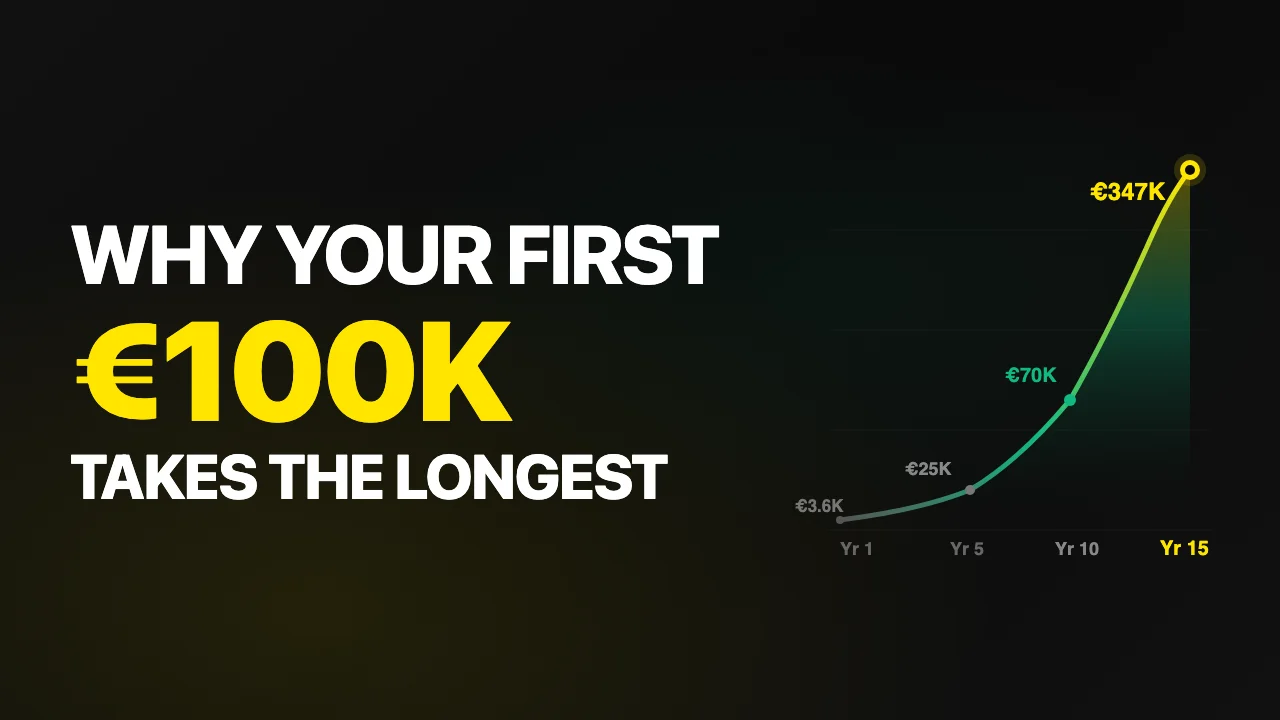
Small amounts genuinely add up over time. If you invested just 50 euros a month starting at age 25 with an average return of 8% per year, by the time you reach 65, you would have over 170,000 euros. The majority of that, around 146,000 euros, comes from compound growth rather than the money you actually put in. This is exactly why the first €100K takes longest, and why starting early matters so much.
The biggest advantage you have as a young investor is not money. It is time. The worst thing you can do is wait until you have "enough" because that day might never come. Start small, stay consistent, and let compounding do the heavy lifting.
4. Listening to Doom Content
On March 9, 2009, the S&P 500 hit its lowest point during the financial crisis. If you picked up the Wall Street Journal that morning, you would have seen the headline: "How low can stocks go?" Reuters was running stories about banking fears and deeper recessions ahead.
That day turned out to be the absolute bottom. From that point, the market went on one of the longest bull runs in history. The S&P 500 grew from around 676 points to over 6,000 points. Nearly a 10x return. If you had listened to the news and stayed out of the market, you would have missed all of it.
S&P 500: 676 points in March 2009 to over 6,000 points in 2026. Investors who sold at the bottom and waited for "good news" missed the entire recovery.
Nearly 10x return, missed.We now live in a world of 24/7 financial content. YouTube, X, TikTok. The algorithm rewards fear. A thumbnail saying "crash is coming" gets 10 times more clicks than one saying "markets look fine, keep investing." There is an entire ecosystem of creators who produce doom content every single day because it works for them. You click on it because you are afraid you might miss something important.
But their incentives are not the same as yours. You want to build long-term wealth. They want views. Being informed is fine, but changing your strategy every time someone on the internet says the sky is falling is not. I experienced this firsthand when I lost $52,000 in a single week. The doom content was deafening, but staying the course was the right call. The flip side of panic selling is just as dangerous, and I break down both sides in panic selling and FOMO buying: the two traps.
5. Not Diversifying Your Investments
This one feels obvious, but you would be surprised how many people think they are diversified when they are really not. If your entire portfolio is an S&P 500 ETF, you are essentially 100% in US large-cap stocks with a heavy lean towards technology. Companies like Apple, Microsoft, Nvidia, and Amazon make up a massive part of that index.
US tech has had an incredible run, but concentrating everything in one country and one sector is a risk no matter how well it has performed recently.
True diversification means spreading your investments across different asset classes and regions. I wrote a detailed breakdown of what a real crisis taught me about diversification, but at a high level, consider spreading across:
- European and emerging market stocks
- Real estate through REITs or physical property
- P2P lending for alternative income (I use Go & Grow (formerly Bondora) for 6% annual interest)
- Gold as a hedge
- A small allocation to Bitcoin if you are comfortable with volatility (stored on a hardware wallet for security)
- Cash as a buffer
The point is not to chase returns in every category. It is to protect yourself when one area of the market is not doing well. If US tech has a rough year, having exposure to other assets means your entire wealth does not take the same hit. You do not need 30 different holdings, but owning more than just one ETF tracking one index in one country is certainly worth thinking about. If you prefer not to pick individual stocks at all, there are several ways to invest passively.
6. Comparing Yourself to Others
This is the mistake nobody really talks about, but it might matter the most. Social media has made it incredibly easy to compare your financial journey to everyone else. You see someone on Reddit posting their half-million portfolio at age 30, or a YouTuber showing their monthly dividend income, and suddenly your 200 euros a month feels pointless.
But here is what you do not see. You do not see the inheritance they may have received. You do not see the six-figure salary. You do not see the years of living at home rent-free. Everyone's starting point is different, and comparing your chapter 1 to someone else's chapter 20 is a guaranteed way to feel terrible about yourself. I share my own portfolio transparently, including the bad months, in my monthly portfolio updates.
The only comparison that really matters is you versus you from last year. Are you investing more consistently? Have you reduced your fees? Are you more disciplined than you were six months ago? That is what actually counts.
100 euros a month invested consistently beats 1,000 euros a month invested randomly whenever you feel like it. Your journey is your own, and the fact that you are even thinking about this already puts you ahead of most people.
The Bottom Line
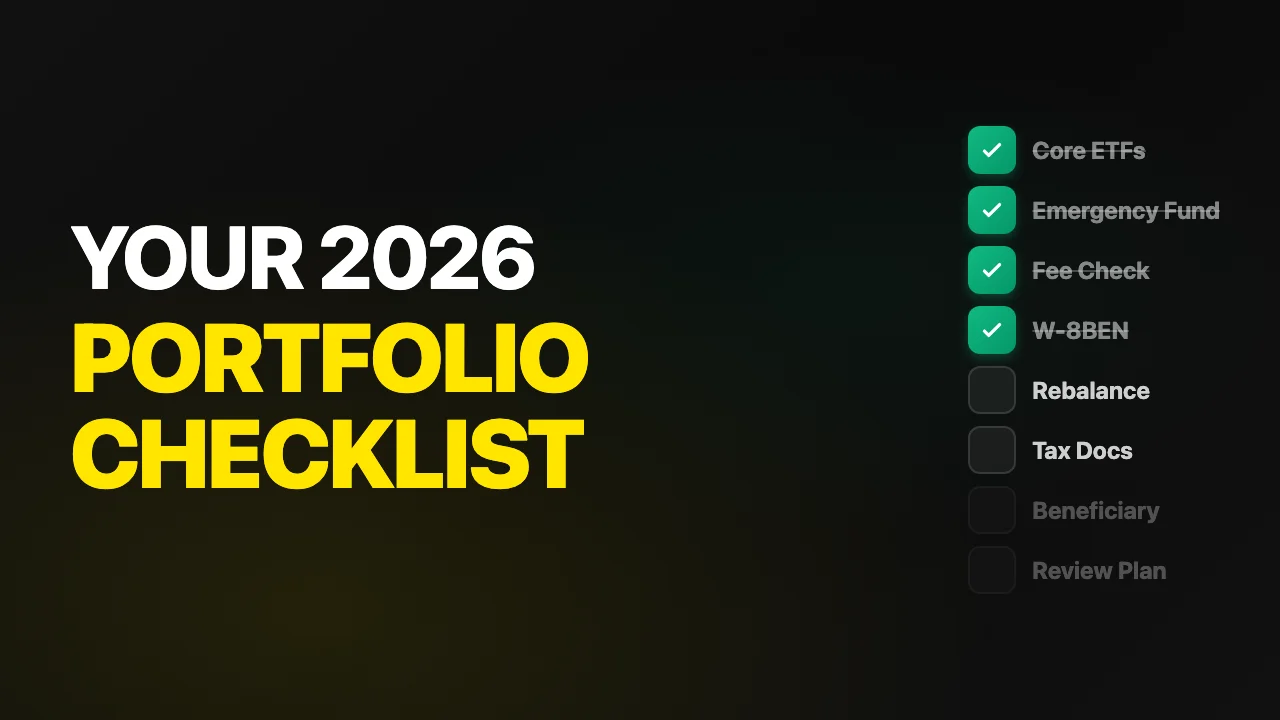
None of these mistakes are complicated to fix, and that is kind of the point. The best investing strategies rarely are. Automate your contributions, keep fees low, diversify properly, ignore the noise, and focus on your own progress rather than someone else's highlight reel. If you want a practical way to stay on top of these fundamentals each year, take a look at my 2026 portfolio checklist.
Frequently Asked Questions
Once a month is enough for most long-term investors. If you find yourself checking daily, try removing the app from your home screen or setting a specific day each month for your review. The less you look, the less likely you are to make emotional decisions. I wrote about why I stopped checking my portfolio during the recent oil shock, and it made a real difference.
Aim for under 0.5% in total costs including platform fees, fund fees, and FX fees. Many modern brokers like Trading 212 charge zero commissions, and index ETFs typically have expense ratios of 0.07% to 0.20%. Anything above 1% total cost is worth reconsidering.
As little as €1 with brokers that offer fractional shares. The amount does not matter nearly as much as the consistency. Starting with €25 or €50 a month and gradually increasing is a perfectly valid strategy. Time in the market matters more than the size of your first deposit.
The best time to start was yesterday. The second best time is today. Even if you are starting later than you would have liked, compounding still works in your favour. A 40-year-old investing €300 a month at 8% returns would still have over €220,000 by age 65.
Almost never. Market downturns are temporary, and selling locks in your losses permanently. Historically, every major crash has been followed by a recovery to new highs. If anything, downturns are buying opportunities for long-term investors who have cash available.
Disclaimer: This article is for educational purposes only and does not constitute financial advice. When investing, your capital is at risk. You may get back less than you invested. Past performance is not a guarantee of future results.
This article contains affiliate links, meaning I may earn a small commission if you sign up through them, at no additional cost to you. eToro is a multi-asset investment platform. The value of your investments may go up or down. Your capital is at risk.