February was a challenging month for my portfolio. Between geopolitical tensions escalating in the Middle East and irrational market reactions to strong earnings, the combined portfolio pulled back to $331,000. Here is a transparent look at everything that happened, what I am holding, and how I am thinking about the months ahead.
Before diving into the numbers, I want to note that this update was originally recorded just before the Iran situation escalated. Being based in Dubai, it was a genuinely frightening few days for my family and me. Thankfully, we are safe, and the situation has been handled well. But it certainly added another layer of volatility to an already turbulent month.
Portfolio Overview: $331K and the Bigger Picture
The combined portfolio now sits at just over $331,000, which puts it back to where it was roughly three months ago. Despite consistent monthly contributions, the market pullback erased recent gains. If I were a day trader, those numbers would be devastating. But with a long-term time horizon, the perspective changes entirely.
When I zoom out to where I started tracking in 2023 at $48,000, the progress is clear. That growth comes from a combination of consistent dollar cost averaging and market appreciation over time. Months like February are part of the journey, not the end of it. If you are still early in your investing journey, I wrote about why the first €100K takes the longest and how the compounding effect accelerates from there.
The biggest factor dragging the portfolio down was Bitcoin, which has been hit the hardest out of all my holdings. Stocks and ETFs actually held up reasonably well on the whole, though several individual positions took a hit.
Stock Holdings: Strong Fundamentals, Irrational Prices
One of the most frustrating aspects of February was watching companies deliver exceptional earnings only to see their stock prices decline. The market has been behaving irrationally, and traditional sentiment analysis no longer seems to apply. In the past, beating expectations would send a stock price surging. That dynamic has clearly shifted.
Amazon: My Highest Conviction Pick
Amazon remains my third-largest holding and the single company I have the most conviction in. Despite posting an incredible earnings report that beat expectations across the board, the stock dropped 13% during the month. If I could only invest in one company, it would still be Amazon.
The reason is simple. Amazon operates like an ETF in itself, with leading positions in e-commerce, cloud computing (AWS), AI through its partnership with Anthropic, satellite internet, robotics, and self-driving vehicles. Whatever they do, they tend to be either number one or number two in that space. I genuinely believe the market has not yet fully appreciated Amazon the way it eventually embraced Google after the Gemini breakthroughs.
NVIDIA and AMD: Crushed Earnings, Punished Prices
Both NVIDIA and AMD delivered exceptional quarterly results, yet both were punished by the market. NVIDIA projected 60% year-over-year growth for the coming year, which would normally send any stock soaring. Instead, it dropped. AMD told a similar story, with strong results met by a declining share price.
This is why I have moved firmly into fundamental investing. I look at where a company will be positioned in five years, not next quarter. We are moving into an increasingly digital and AI-driven world, and hardware companies providing cloud infrastructure, chips, and compute power are well-positioned for that future.
Emaar: UAE Real Estate Strength
One of my best recent investments has been Emaar, the developer behind the Burj Khalifa and Dubai Mall. Over a three-month period, the stock gained 14%, and a dividend of approximately 7% is expected in April. The geopolitical tensions could affect the short-term price, but the UAE markets were temporarily closed as a precaution, which should help cushion the impact.
TSM and ATI: Surprise Performers
TSM (Taiwan Semiconductor) has been a position I was initially hesitant about due to geopolitical risk. But given that they produce around 90% of the world's chips and every major chipmaker depends on them, the fundamental case is strong.
The biggest surprise was ATI, a defense company that surged 30% in just one month. Unfortunately, it was my smallest position at the time, with only $3,000 invested. That has since grown to $4,000, and the position has moved up two places in my portfolio rankings. I discovered ATI through Seeking Alpha's top 10 stocks for 2026, and the investment thesis has paid off handsomely.
ETFs: The Steady Foundation
My S&P 500 and NASDAQ 100 ETFs took a small hit but held up better than most individual stocks. This is the beauty of ETF investing. You do not need to worry about which specific industry or company will outperform because you simply follow wherever the broad market goes. For anyone unsure about picking individual stocks, ETFs remain one of the safest and most effective ways to invest. I covered several ways to invest without picking individual stocks if you want to explore that route.
Bitcoin: The Biggest Drag
Bitcoin continues to be my single largest holding at 33% of the total portfolio. It was also the biggest contributor to February's decline. I still believe in the long-term fundamentals, which is why I hold no other cryptocurrency apart from a small amount of Nexo tokens tied to the Nexo platform.
However, I am not planning to add more Bitcoin at this point. The allocation is already quite high relative to my total portfolio, and I would rather deploy fresh capital into stocks where I see more immediate value. I am also planning to move my Bitcoin from the Nexo platform to my Ledger hardware wallet for full self-custody. With lower crypto prices increasing platform risk, the roughly $90 per month in interest from Nexo does not justify the counterparty risk.
Why AI Will Reshape Software Valuations
One of the themes I have been thinking about is the impact of AI on traditional software companies. Companies like Salesforce, once Wall Street darlings, are down significantly over multi-year periods. I believe AI will continue to disrupt software in ways that many investors underestimate.
As someone deep in the AI space, I can tell you that tools like Claude allow me to build fully functional software, recording tools, dashboards, and custom applications, without any coding background. I simply describe what I need, and the AI builds it. This capability is improving rapidly, and it will inevitably compress the valuations of traditional software businesses.
That is a major reason why I remain focused on hardware and infrastructure companies rather than software. The companies building the chips, cloud infrastructure, and compute capacity that power AI are the ones I want to own for the next five to ten years.
P2P Lending: Predictable Income in Volatile Times
When the stock market moves sideways or drops, my P2P lending portfolio provides a welcome counterbalance. In February, it generated $142 in interest across two platforms: Go & Grow (formerly Bondora, earning 6% annually) and Monefit SmartSaver (earning 7.5% annually). I wrote a detailed Go & Grow review if you want to see how it works.
Go & Grow continues to impress with its simplicity. I deposit money, it earns 6% daily interest, and I can withdraw the full amount at any time within a few hours. Monefit offers higher rates at 7.5% on the standard account and up to 10.52% on locked vaults, though same-day withdrawals are limited to €1,000 per month.
Between both platforms, the passive income is steady and predictable, which is exactly what you want when equity markets are choppy.
Passive Income Breakdown: $740 for February
Here is how my passive income broke down for the month:
| Income Source | Amount |
|---|---|
| P2P lending interest (Go & Grow + Monefit) | $142 |
| Cash interest (UAE, 6%) | $450 |
| Credit card cashback | $110 |
| Dividends | $0 |
| Total | $740 |
$740 in passive income regardless of what the stock market does. Building multiple income streams has been a key part of my strategy, and months like February show exactly why it matters.
Broker Setup and Next Goals
I currently spread my investments across three main brokers: eToro (my largest single broker), Interactive Brokers, and Trading 212. I also have a small position at XTB that I may build over time. If you are comparing options, I put together a broker comparison for 2026.
eToro is a multi-asset investment platform. The value of your investments may go up or down. Your capital is at risk. Sponsored link.
My next milestone is hitting $100,000 inside eToro with next month's contributions. Beyond that, I am aiming for the $250,000 Diamond member threshold, which unlocks additional perks and benefits on the platform.
Lessons from a Tough Month
February reinforced several principles that I keep coming back to as a long-term investor:
- Do not try to time the market. Technical analysis and sentiment-based trading are becoming less reliable in an AI-driven market. Focus on fundamentals instead.
- Down months are buying opportunities. It is interesting to see people lose interest in investing when markets drop. That is actually the worst time to disengage and the best time to deploy capital.
- Diversification works. When stocks struggle, P2P lending and cash interest provide stability. Spreading risk across asset classes is not optional. I wrote a full breakdown of my diversification strategy if you want to see how I structure it.
- Zoom out. A $48K portfolio in 2023 growing to $331K today tells a completely different story than one red month in isolation.
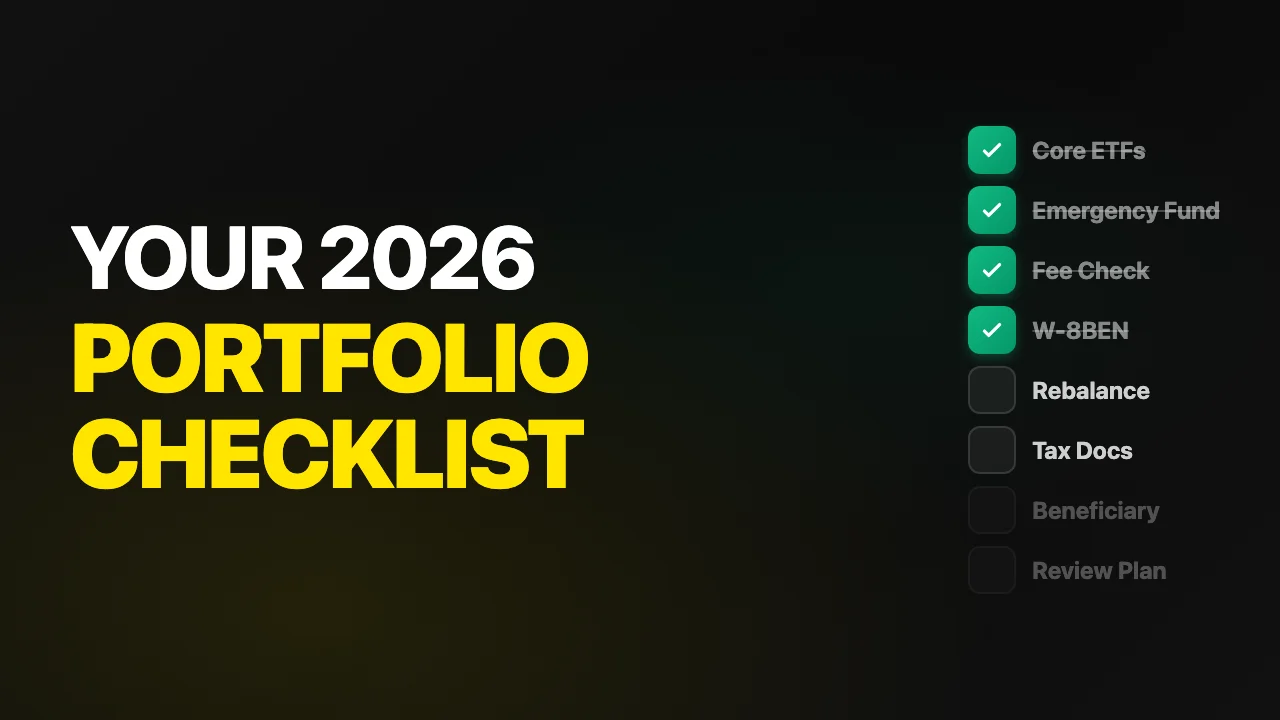
Markets never go up in a straight line. They are cyclical, and short-term volatility is the price you pay for long-term wealth building. Strong companies will sort themselves out over time. All I can do as an investor is find fundamentally strong businesses or ETFs, diversify across asset classes, and continue dollar cost averaging through the noise. If you are reviewing your own portfolio, my 8-point portfolio checklist is a good place to start, and make sure you are not making any of these common investing mistakes.
Update: See what happened next in my March 2026 portfolio update, where I had my biggest buying month ever despite the fifth consecutive red month.
Frequently Asked Questions
I aim to invest a consistent amount every month through dollar cost averaging. The exact figure varies depending on my income that month, but the key is consistency rather than trying to time the market. Even small amounts compound significantly over time.
Each broker serves a different purpose. eToro is my main broker for US stocks and social investing. Interactive Brokers gives me access to global markets with low FX fees. Trading 212 offers commission-free trading. Using multiple brokers also reduces the risk of having all my investments at a single institution.
eToro is a multi-asset investment platform. The value of your investments may go up or down. Your capital is at risk. Sponsored link.
It is higher than what most financial advisors would recommend. Bitcoin grew to 33% of my portfolio through price appreciation rather than me deliberately allocating that much. I am comfortable with the risk given my overall diversification across multiple asset classes, currencies, and countries, but I am not adding more at this level.
My passive income comes from four sources: P2P lending interest (mainly Go & Grow at 6% and Monefit at 7.5%), cash interest from a UAE savings account (6%), credit card cashback, and stock dividends. The goal is to build income streams that pay regardless of market direction.
Historically, buying during downturns has been one of the most effective strategies for long-term investors. The key is having cash available to deploy. I keep reserves earning interest so I can act when prices drop, which is exactly what I did during the market crash that cost me $52,000 in one week.
Disclaimer: This article reflects my personal investment experience and is not financial advice. All investments carry risk, and you may get back less than you invest. Past performance is not a guarantee of future results. Always do your own research before making investment decisions. This article contains affiliate links, meaning I may earn a small commission if you sign up through them, at no additional cost to you.
eToro is a multi-asset investment platform. The value of your investments may go up or down. Your capital is at risk.